
The Problem Comes Before AI
A return to the foundations of human-centered design in the AI age
TL;DR
Before reaching for AI, identify where your workflow repeatedly fails. Understand who is affected, gather evidence, and decide priority. Then develop possible solutions, including, but not limited to, AI, and evaluate them against cost, risk, feasibility, and measurable outcomes.
Your boss, and their boss: “How can we use AI?”
Generating mockups, user flows, components, visuals, and other design artifacts with AI for your product is more “efficient” than ever. Faster production is useful. But faster production without clear judgment creates design debt at greater speed. There is a more disciplined way to adopt AI in your design process.
Too often people, and especially executives, ask: “How can we use AI?” But this framing is backward. It begins with a preferred solution and asks designers to manufacture a problem for it. Human-centered design is supposed to move in the opposite direction: understanding the problems before committing to an intervention.
Ironically, many of the people asking this question call themselves human-centered design professionals. But HCD does not treat the invention of a technology as evidence that people need products built with it. We saw the same pattern with NFTs. Too many sunken ships because they begin with “What can we put on chain?” rather than “What problems are we solving?”. Many of those products fail because technological novelty was mistaken for product value. Now AI is inviting the same mistake at a much bigger scale.
Double-diamond
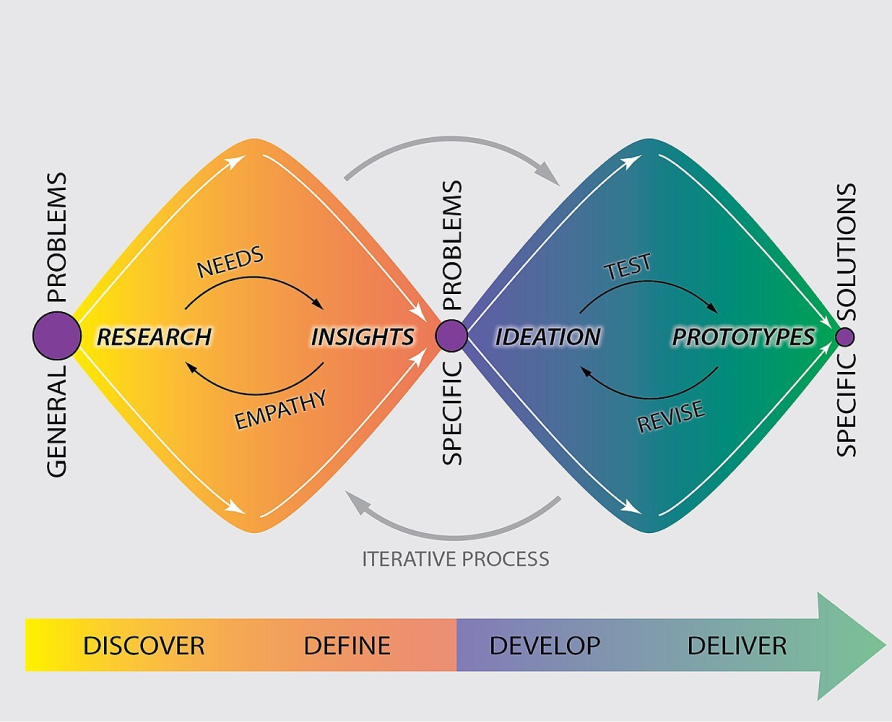
Let’s throw away any thoughts, or paranoia, about AI for a second. And take a look at this diagram. Most product people have encountered this diagram. But under pressure to adopt AI, we behave as though we have forgotten its most basic lesson: understand the problem before committing to a solution.
Important: The Double Diamond is not linear. You may move backward when testing a weak assumption. Its value here is simply that it separates understanding the problem from committing to a solution.
Discovery
In discovery, we need to understand the issue, speak to and spend time with people who are affected by it, find out which problems are common. Take notes. These are your raw contextual data to approach a better workflow. (a.k.a. the yellow stickies in Contextual Design) We are looking for repeated failures, not hypothetical AI opportunities.
Define
In Define, frame each discovery clearly and decide what actually matters. Multiple designers may be experiencing variations of the same underlying problem. When you consolidate the raw observations, what patterns emerge? For example:
- Maintaining design consistency across 20 designers in a remote environment is difficult.
- Platform constraints are scattered across Slack, Jira tickets, Confluence articles, and developers’ heads.
- Past decisions were not recorded, so their reasoning has been forgotten. Even when we create documentation, maintaining it requires substantial work and may produce another scattered source.
At the same time, define what success would look like:
- Why are you solving this?
- Who is affected?
- What evidence supports it?
- How important is it relative to other problems?
- What measurable outcome would represent improvement?
Develop
Ideate solutions, including AI. We should always consider non-AI solutions alongside AI. They are not automatically cheaper or better, but we need to make sure the tool choice follows the problem.
For my example of maintaining design consistency, some solutions are
- Weekly group meeting; round-robin to present work: This seems to make sense compared with an AI solution. However, in reality, people turn off their cameras and stop presenting and speaking up. It is also not realistic for everyone to show all the work they are building in a one-hour meeting
- 10-min sync with each designer to make sure alignment: This works great for smaller teams. We cannot spend 200 minutes a week for design alignment.
- Figma Agent to compare proposed designs with approved patterns: This solves the problems above. The challenge is how to establish which files are readable and authoritative
Develop is where creativity should shine. There are no bad ideas. Try to build ideas on top of your ideas. You can narrow down what is doable in the Deliver phase.
Deliver
Finally, narrow down each solution by
- the cost
- technical reality
- effectiveness
- risk
Then iterate your solutions. Run small experiments with them. See what works best based on the success metrics you defined.
Take the Figma Agent consistency example: The experiment could begin with one team and one approved pattern library. Success would mean fewer consistency issues reaching design review. Every recommendation by the agent should point back to the approved source rather than presenting the agent’s judgment as authoritative.
Trust the process
The mature question is never “How are we adopting AI?” It is “Where is our workflow failing?” Sometimes the answer will be AI. Sometimes it will be a document, a meeting, or simply asking the engineer sitting next to you. “Trust the process”. Human-centered design has been tested and refined over decades. It does not guarantee the right answer, but it makes us examine the problem before committing to an answer.
Next time when someone proposes an AI initiative, ask:
- Discover: Where does the workflow repeatedly fail?
- Define: Which failure matters, to whom, and how will improvement be measured?
- Develop: What AI and non-AI interventions could address it?
- Deliver: Which option survives testing against cost, risk, feasibility, and outcomes?